
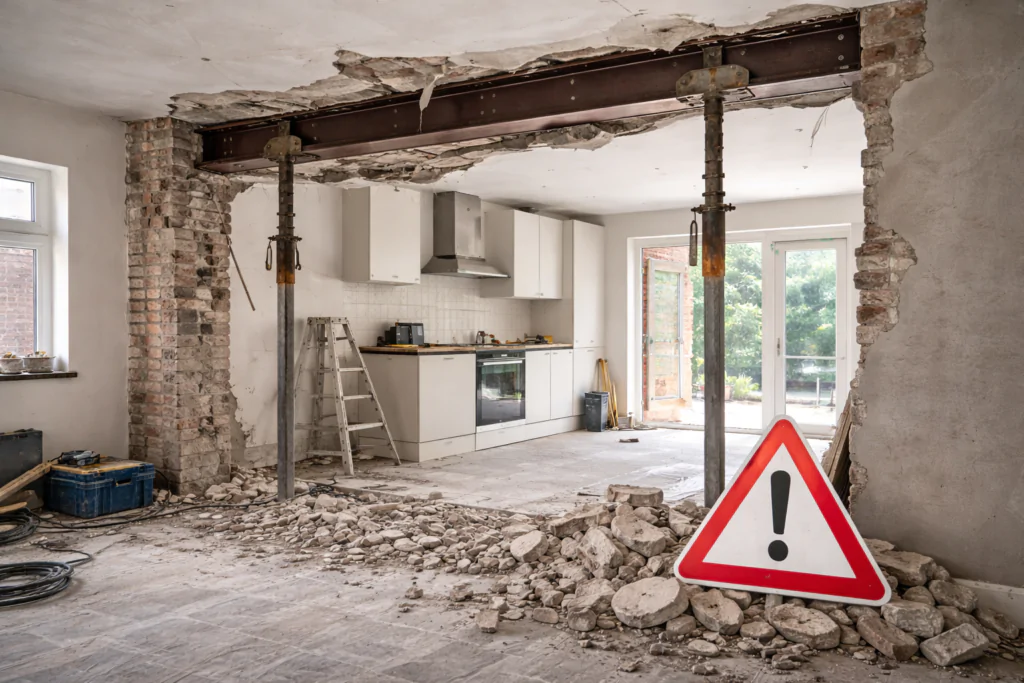
What Happens If You Remove a Load Bearing Wall Without Calculations in Manchester?
Across Manchester, from the Victorian terraces of Levenshulme to the 1930s semi-detached homes in Wythenshawe, open-plan living is a priority for many homeowners. Knocking down an internal wall to connect a kitchen and dining room is often the single most effective way to transform a property.
However, in the rush to get the work done, a critical step is sometimes missed: structural calculations. Some homeowners assume that simply putting in a steel beam is enough, or they rely on a builder who assures them they "do this all the time." Some property owners attempt to remove a load bearing wall without a structural engineer in Manchester to save on fees, but this decision often leads to significant complications.
Removing a load-bearing wall without professional design calculations is a significant risk. It affects the safety of your home, your legal standing with Manchester City Council, your insurance policy, and your ability to sell the property in the future. This article explains the practical consequences of skipping this essential stage.
Why homeowners remove a load bearing wall without a structural engineer in Manchester
It is rare for a homeowner to intentionally ignore safety rules. Usually, the removal of a wall without calculations happens due to a misunderstanding of how buildings work or misplaced trust in a builder's informal advice.
The "Builder Said It's Fine" Scenario
Builders are skilled at construction, but they are not structural designers. A builder might look at a wall in a typical Manchester terrace and assume that a standard steel beam, often referred to as an RSJ, will do the job because they used one in a similar house down the street.
However, even identical-looking houses can have different load paths. One might have a heavier tiled roof while another has slate. One might have had previous alterations that shifted weight onto the wall you want to remove. Without calculations, the builder is guessing.
Assuming It Is Non-Load Bearing
Some homeowners tap a wall, hear a hollow sound, and assume it is a stud partition that carries no weight. In many older Manchester properties, load-bearing walls were lathed and plastered, or stud walls were added later to support sagging joists. Sound is not a reliable indicator of structural function.
Immediate Physical Risks to the Building
If a load-bearing wall is removed without a calculated support system, the effects on the building can be immediate and severe.
Sagging Floors and Ceilings
The most common issue is deflection. If the installed beam is too small for the span, or if the wall was removed without any beam installation, the floor joists above will begin to sag. This usually manifests as cracks in the ceiling plaster, doors on the floor above sticking in their frames, or skirting boards separating from the floor.
Unstable Masonry
In Victorian terraces, the internal spine walls often provide lateral stability to the whole house. Removing a large section without considering how the remaining brickwork is supported can leave the masonry above unstable. This can lead to "corbelling" failures or masonry crushing at the points where the beam rests.
Inadequate Bearings
Calculations do not just size the beam; they size the "padstones." These are the dense blocks of concrete that the beam sits on. If a builder installs a heavy steel beam directly onto standard brickwork without a calculated padstone, the bricks can crush under the concentrated load. This causes significant cracking and structural movement.
Building Control Consequences
Under the Building Regulations, specifically Approved Document A, any structural alteration requires approval from a Building Control Body. This is usually Manchester City Council, Salford City Council, or a private approved inspector.
The Site Inspection
If you have submitted a Building Notice, the inspector will visit the site. They will look at the steel beam and ask to see the structural calculations that prove it is strong enough.
If you cannot produce these calculations, the inspector cannot sign off on the work. They have no evidence that the beam is safe. They will likely issue a contravention notice or simply refuse to issue a completion certificate until the engineering evidence is provided.
Building Notice vs Full Plans
- Full Plans Application: You submit the engineer’s calculations and drawings before work starts. The council checks them and approves them on paper. This is the safe route.
- Building Notice: You tell the council you are starting work and they check it as you go. This is risky for structural work because if the inspector spots an error on site, you have to fix it physically, rather than just changing a drawing.
What "Retrospective Approval" Involves
If you find yourself in a position where work has been done without calculations, you will need to apply for "Regularisation" for work done after 1985. This is not a paperwork exercise; it is an intrusive and disruptive process.
Opening Up Works
An engineer cannot calculate the strength of a beam they cannot see. Nor can a Building Control officer inspect a beam covered in plasterboard. You will be required to cut holes in your new ceiling to expose the beam and hack off plaster to reveal the padstones and brickwork bearings.
The Engineer's Assessment
You will then need to hire a structural engineer to perform retrospective calculations. They will measure the span, check the loads from the roof and floors, and calculate whether the installed beam is sufficient. If you proceed to remove a load bearing wall without a structural engineer in Manchester, you risk the beam being undersized.
The Risk of Rejection
If the retrospective calculations show that the beam your builder installed is too weak, or the bearings are insufficient, you have a major problem. You cannot simply "add strength" to a weak beam. The likely remedy is propping up the ceiling again, ripping out the new beam, buying and installing a larger beam, and then re-plastering. This effectively means paying for the job twice.
Costs in Time and Disruption
The financial impact of proceeding without calculations extends beyond the engineer's fee.
- Delays: Work may be stopped by the local authority while calculations are produced. This can stall your kitchen fitting or flooring installation.
- Remedial Work: If the beam is wrong, the cost of labour and materials to replace it is substantial.
- Making Good: Cutting inspection holes in a newly finished room ruins the finish. You will face costs for patching, skimming, and repainting.
- Stress: Living in a construction site for weeks longer than planned is a significant burden on homeowners.
Property Sale and Solicitor Checks
For many homeowners, the issue only comes to light years later when they decide to sell the property.
The Buyer's Solicitor
During the conveyancing process, the buyer's solicitor will ask for the Building Regulations Completion Certificate for the wall removal. If you cannot provide this because the work was never notified or approved, the sale can hit a wall.
The Completion Certificate
This certificate is the official proof that the work is safe. Without it, you are selling a property with a known legal and structural defect.
Indemnity Insurance Limitations
Solicitors often suggest "Indemnity Insurance" as a quick fix. This policy covers the buyer against the council taking legal enforcement action. However, it does not cover the buyer for the cost of repairing the wall if it collapses or sags. Many prudent buyers, or their mortgage lenders, will refuse to accept an indemnity policy for structural work because it does not guarantee the house is safe to live in.
Insurance and Liability Implications
Your home insurance policy requires you to keep the property in a good state of repair and to comply with statutory regulations.
Invalidating Your Policy
If you undertake illegal building work (work without Building Regulations approval), your insurer may refuse to pay out in the event of a claim. For example, if the roof sags and causes a leak, or if the masonry collapses, the insurer will investigate. If they find an unapproved structural alteration caused the damage, you are liable for the entire cost of repairs.
How to Avoid the Problem
Avoiding these risks is straightforward. It requires following the correct sequence of work.
- Don't Start Demolition Yet: Do not let a builder knock down anything until you have a plan.
- Hire a Structural Engineer: Before you hire a builder, get a structural engineer to visit. They will assess the loads and produce the calculations.
- Get Drawings: Ensure the engineer provides a "Structural Drawing" or sketch. This tells the builder exactly what beam to buy and how to install it.
- Submit Full Plans: Send the calculations and drawings to Manchester Building Control (or your private inspector) for approval before work starts.
- Hire the Builder: Give the approved drawings to your builder so they can quote accurately and build safely.
Summary
Removing a load-bearing wall without calculations is a gamble that rarely pays off. While it might save a small amount of time and money at the start of a project, the potential consequences include unsafe masonry, sagging floors, invalidated insurance, and collapsed property sales.
In Manchester, where housing stock is often older and shared with neighbours, the structural integrity of your home relies on precise load management. The only way to ensure this is through professional structural calculations and Building Control oversight.
If you are planning this type of work, our load bearing wall removal service in Manchester explains what is involved and how the process works.